Most businesses spend more energy crafting the message than understanding what the customer needs to hear.
Right now, someone is typing something into Google that your business could answer. A question about your industry, a comparison between you and a competitor, or a problem they are trying to solve before the end of the week. They are looking for help, and they are going to click on the first result that looks like it has it. Is that you? For most businesses the honest answer is no. Not because the product is wrong or the team is not working hard enough, but because the marketing was built around the wrong question.
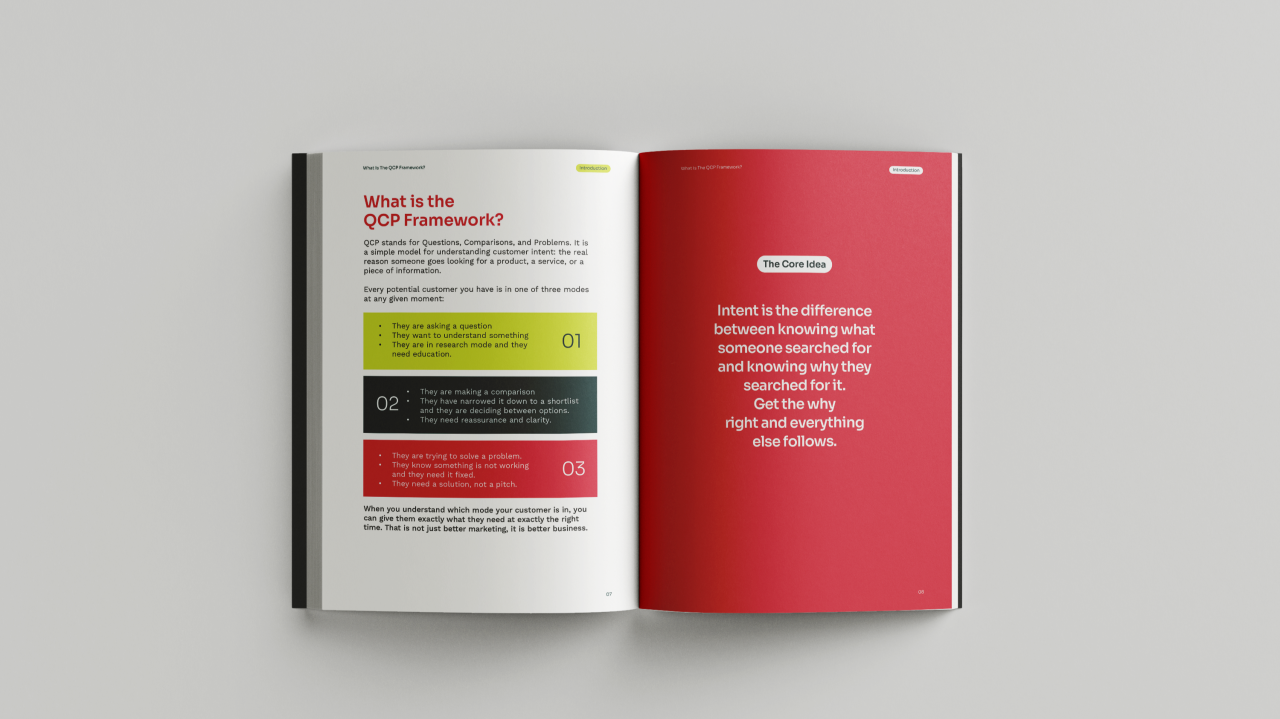
Intent is the difference between knowing what someone searched for and knowing why they searched for it. Get the why right and everything else follows.
The QCP Framework
The wrong opening question
Most marketing starts here: what do we want to say? The question it should start with is: what does our customer need to hear right now? That gap, between what you are saying and what your customer needs to hear, is where most marketing quietly falls apart. I have spent years watching businesses invest real money in content, advertising and brand activity that does not land. The creative is often good. The targeting is reasonable. But the content is built around what the business wants to communicate rather than what the customer is actually looking for. The customer, who arrived with a question or a problem or a decision to make, leaves without any of those things resolved.
Three modes, one framework
What I kept finding, across industries and business sizes, is that customers tend to be in one of three modes before they buy. They are asking a question: they want to understand something, they are in research mode, curious but not close to a decision. They are not looking for your product yet, they are looking for an answer to something that is making them uncertain. They are making a comparison: they have done some research and now they are choosing between options, looking at who is most credible, who has the best evidence and who is most honest about what they offer. This is where decisions actually get made, and most businesses have almost no presence here. Or they are trying to solve a problem: something is not working and they need it fixed. They are not browsing, they are looking for a way out of a situation, and they will act quickly when they find someone who understands it. I call this the QCP Framework: Questions, Comparisons, Problems. It is a model for mapping customer intent and building marketing that meets people where they actually are.
Each mode needs a different response
A customer asking a question needs education, not a pitch. A customer making a comparison needs evidence and transparency, not enthusiasm. A customer in problem mode needs to feel understood before they need to feel persuaded. Most businesses treat all three the same. They produce content about what they do, who they are and why they are good at it. That content answers none of these questions. It speaks to no specific mode. It is marketing talking to itself.
Why the shift matters
When you build content around customer intent rather than brand messaging, something changes. The content starts connecting, not because it is better produced or more frequent, but because it is more useful. A blog post that answers a specific question your customer is asking will build more trust than ten posts about your team’s values. A case study told through the lens of a client’s real problem will do more selling than a list of services. A pricing page that honestly addresses the comparison a customer is already making will convert better than a page that just says “get in touch for a quote”. The shift is not complicated. It requires a different question at the start of every piece of content you create: what is my customer actually trying to do right now? That question changes what you write, how you write it and where you put it.
Where to start
The simplest place to begin is your own inbox. Go back through the last six months of customer enquiries and read what people actually asked before they bought. What were they trying to understand? What were they comparing? What problem were they sitting with when they reached out? That is your content brief. Those questions are the articles you should be writing. Those comparisons are the pages that should be on your website. Those problems are the opening lines that should be on your homepage. You do not need a bigger budget or a content team to apply this. You need to pay attention to what your customers are already telling you and start responding to it. The marketing that connects is the most relevant, and relevance starts with understanding what your customer is actually trying to do.
Clear thinking about strategy, brand and building things.